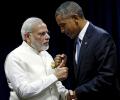
Even as Barack Obama administration officials believe that the India-US relationship has now "emerged at the world stage" and is no longer a "restricted to narrow" South Asia or subcontinental set of issues, they also concede that America's security partnership with Pakistan over the years still poses challenge to India-US relationship.

'While economic ties are making incremental progress, it is in the security and strategic domains that the India-Japan synergy is more compelling,' says Dr Rajaram Panda.

India and South Africa on Friday agreed to deepen engagement in key areas of defence production, manufacturing, mining and minerals and combating terrorism.
'India appears to have stood its ground on strategic autonomy by resisting US pressure on Russia, China and Iran, but succumbed to the temptation to walk into a tighter embrace in defence cooperation, a high priority of the Trump administration,' notes Ambassador T P Sreenivasan.

'Of all the areas that define the future for a strong US-India partnership, none is more important than our defence and security ties.'

China will also set up 50 joint laboratories with countries participating in the Belt and Road initiative to enhance cooperation on innovation.

The new government needs to clearly insist on diplomatic reciprocal arrangements with China. While reciprocity is a function of power in bilateral relations, the Modi-led government's responses should be based on India'S inherent strengths, says China expert Srikanth Kondapalli.

'While visits and personal meetings are useful, changes of strategic significance have occurred recently, with Beijing trying to take the lead which Modi must take note of.'

'The men in black suits and hair dye in Beijing have not only completely blown the cover story of "peaceful rise," but have managed to antagonise regional powers in the Indo-Pacific.'

The joint statement issued after Prime Minister Narendra Modi and President Barack Obama's first-ever summit is high on intent and ambition. Notably missing from the statement is India's refusal to be America's partner in its war against ISIS.

Trade between India and Indonesia stands at $20 billion.

RM took stock of progress in production of the fighter jets whose delivery to India will begin in September next year.

'Both Modi and Xi know that if all that there is to show for Modi's visit -- barely eight months after Xi's India trip -- is a repeat of the same old declarations, there will be a terrible sense of letdown in the public mood resulting in future summits losing credibility. Only the possibility of new ground being broken can justify Modi's trip at this time,' says B S Raghavan.

The two PMs called upon all countries to work towards rooting out terrorist safe havens and infrastructure.

Chinese President Xi Jinping has suggested five thrust areas to improve relations with India. It is likely all these issues, in addition to the points raised by Xi at Fortaleza, will be part of the joint declaration at the end of his visit to India, says Srikanth Kondapalli.

'Modi and Obama both had agendas that went beyond the nuclear deal. The threat from the chilly Himalayas had to be tackled in the warm waters of the Indian Ocean.'

'The past year has yielded extraordinary results in the strategic, commercial, and people-to-people components of the India-United States partnership, US Ambassador to India Richard Rahul Verma tells Aziz Haniffa/Rediff.com in an exclusive interview.

'This is the first time that the Americans have agreed to refer to "cross-border terrorist attacks" in a joint statement.' 'No wonder Pakistan has called the joint statement "singularly unhelpful" and has blasted it, and its all-weather friend China has applauded Pakistan's frontline role in combating terrorism,' points out former foreign secretary Ambassador Kanwal Sibal.

Moving ahead with their new mantra -- Chalein Saath Saath: Forward Together We Go -- Prime Minister Narendra Modi and United States President Barack Obama on Tuesday vowed to deepen cooperation in every sector for the benefit of global stability and people's livelihoods over the next ten years.

'Xi Jinping got a dose of Modi's medicine inside the tent where he was being hosted on the banks of the Sabarmati river.' 'Modi reportedly told him, looking deep into his eyes: "This was not expected of your country. Can you tell me when the troops are withdrawing?".'

Modi's visit to some developed countries such as the US, Japan, China and Australia were sprinkled with humongous investment figures. But do we have the wherewithal to absorb such big investments?

From early indications, the Modi government's foreign policy seems to be pragmatic and reciprocal, says K G Suresh.

'The US wants Modi to succeed because we want India to succeed. For our part, when India thinks of its partners in the world, we want it to think of the US first. That means positioning our country as the preferred provider of the key inputs that can help to propel India's rise.' 'The meeting between Modi and Obama is, and must be, an opportunity for true strategic dialogue -- not a scripted exchange of talking points, but an open discussion of the big questions. What kind of world do we want to live in? What are our true priorities? And most importantly, why does this partnership still matter?'

After Pyongyang tests a missile potentially capable of reaching the US, Dr Rajaram Panda explores the realistic -- and peaceful -- options before Donald Trump and the international community at large.

PM Modi seems to be gradually ending India's strategic ambiguity

Continued uncertainty or confrontation in the Asia-Pacific is clearly in no one's interest as it will affect major powers' attempts to restructure their economies and revive growth. Conflict would roll back the gains to each of our countries of 40 years of stability and peace, says Shivshankar Menon.

'The Modi-Xi and Modi-Obama meetings, with an interval of just 12 days, are juxtaposed superbly at a crucial point in the prime minister's life. Can Modi carve out a win-win situation with the superpower and the emerging superpower at the same time?'

Prime Minister Narendra Modi on Tuesday said Australia will not be at the periphery of India's vision but at the centre of its thought, as he called for closer bilateral security cooperation and a comprehensive global strategy to tackle the menace of terrorism.

'India alone cannot walk the path of peace. It also has to be Pakistan's journey to make,' says Prime Minister Narendra Modi at the government's geo-political flagship initiative "Raisina Dialogue-II".

Text of PM Narendra Modi's press statement after delegation level talks with US President Obama at the Hyderabad House in Delhi.

'The book has immense value because it reveals the inner workings of the think-tank which appears to provide facts and insights to Modi, though he himself takes the final decisions and articulates them in his characteristic rhetorical style,' says Ambassador T P Sreenivasan.

Modi's arrival has changed the optics of the visit. There is a different demonstration of the confidence level in the Indian leadership, but not much has changed beyond that, reports Sheela Bhatt/Rediff.com.

'We are completely engaged in fighting poverty; alas, our neighbour Pakistan seems only engaged in fighting us.'

This is the joint statement issued by the ministry of external affairs on the visit of US President Barack Obama to India.

Once again an Indian prime minister has realised that with Pakistan and China, things will not move as he wishes.

'The intrusion in Chumar, during and beyond the Chinese president's visit, is unprecedented and has qualitatively changed the tone of the India-China relationship,' says Jayadeva Ranade, a member of the National Security Advisory Board.

India and China on Wednesday signed in all nine agreements, including the Border Defence Cooperation Agreement and one on strengthening cooperation on trans-border rivers, after restricted and delegation-level talks that lasted over two hours as Prime Minister Manmohan Singh and Premier Li Keqiang met for the second time this year for talks which the Indian leader described as "fruitful and productive".

With facts and figures, the CAG report has highlighted how Gujarat was far from a role model for states across India, and that the progress made in this province in western India in improving agriculture, education, healthcare and empowerment of women and children, was not exactly creditable, says Paranjoy Guha Thakurta.

A sensational interview on India-China ties, with the man most qualified to answer.
 © 2026 Rediff.com - Advertise with us - Disclaimer - Privacy Policy - Sitemap - Feedback - About us - Terms of use - Grievances